
Two firms, same week. One pays $140 for a car accident lead in a mid-sized Midwestern state. The other pays $320 for what the vendor calls the same product in a large Sun Belt state. The second firm assumes it’s being overcharged. [PINPOINT DATA: swap in a real state pair, or label these figures illustrative.]
Usually it isn’t. The price tracks two things: how many firms are bidding for the same claimant, and what a signed case is worth once state law decides what the claimant can recover. Learn to read those inputs and you can price a state before you buy into it.
What sets the price for car accident leads
Five inputs do most of the work.
Advertiser competition for car accident leads
States with dense metros have more PI firms bidding on the same searches. Each extra bidder raises the cost of reaching a claimant, and that cost flows into statewide lead pricing. Markets like Los Angeles, Dallas and Atlanta are some of the most expensive in the country to advertise in.
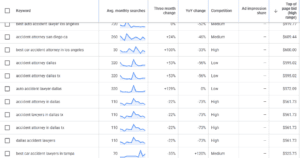
Car Accident Lawyer Search Volume
More crashes produce more claimants searching for lawyers to help with their case. They also pull more firms into the state, so high volume rarely lowers the price on its own.
Tort rules
Two rules decide how many crashes become viable bodily injury claims: whether the state is at-fault or no-fault, and how it treats a claimant who shares blame. Where more crashes qualify, each lead is worth more to a firm.
Insurance limits and case value
Higher minimum coverage and higher typical verdicts raise the ceiling on what a firm can pay to acquire a case. This in turn drives competition as law firms will pay more for leads, given the higher fees they’ll earn on each case.
Exclusivity
An exclusive car accident lead goes to one firm. A shared lead goes to several, and your odds of signing that claimant drop with every extra buyer. Settle this question for each state before you compare prices.
Car accident leads by state: four examples
[PINPOINT DATA: add pricing by state.]
Texas car accident leads
Texas is an at-fault state with heavy advertiser competition in its largest markets. Under the state’s proportionate responsibility statute, a claimant found more than 50% at fault recovers nothing (Tex. Civ. Prac. & Rem. Code § 33.001). Claimants often call several firms, so intake speed decides who signs.
Florida car accident leads
Florida pairs high accident volume with heavy competition, and its tort rules changed in 2023. HB 837, signed March 24, 2023, moved the state from pure to modified comparative fault, so a claimant more than 50% at fault now recovers nothing. It also cut the negligence filing deadline from four years to two for claims that arose after that date (American Bar Association summary). Ask any vendor how its Florida leads converted before and after March 2023.
Georgia car accident leads
Georgia’s fault bar sits one point below Texas’s: a claimant 50% or more at fault recovers nothing (O.C.G.A. § 51-12-33(g)). A crash where fault splits evenly is a viable claim in Texas and a dead one in Georgia, and that difference shows up in how many Georgia leads become signed cases.
California car accident leads
California uses pure comparative fault, adopted by the state Supreme Court in Li v. Yellow Cab Co. (1975). A claimant 80% at fault can still recover 20% of their damages, so more crashes produce a viable claim. Case values run high, and so does advertiser competition. Expect a high cost per lead and claimants who sign with whoever reaches them first.
Rank states by cost per signed case
A low price per lead can signal a state with few viable auto accident cases, or non exclusive leads sold to several firms at once. The price sheet shows neither.
Take two states worked by the same intake team. The numbers below are invented to show the method, so replace them with your own.
| State A (lower price) | State B (higher price) | |
|---|---|---|
| Price per lead | $150 | $300 |
| Signing rate | 5% | 12% |
| Leads needed per signed case | 20 | about 8.3 |
| Cost per signed case | $3,000 | $2,500 |
| Average case fee | $7,000 | $9,000 |
| Fee per $1 of acquisition cost (ROAS) | $2.33 | $3.60 |
State B charges twice as much per lead and still signs each case for $500 less. Every acquisition dollar there returns $3.60 in fees, against $2.33 in State A.
How to compare states before you commit budget
- Pull your signing for car accident leads rate by state for the last 12 months. For a state you haven’t run, borrow your closest comparable and mark it as an estimate.
- Estimate average fee by state from closed files. Use fees actually collected, since claimed case value overstates it.
- Divide price per lead by signing rate to get cost per signed case.
- Divide average fee by cost per signed case, and rank states by the result.
- Ask each vendor how many firms receive each lead in that state.
- Before entering a new state, check its bar rules on paying for leads and on how vendors generate them. ABA Model Rule 7.2 and its comment on lead generators are a starting point. State rules differ, and compliance falls on the firm.
What to ask a vendor about pricing by state
- How does your price here compare to the neighboring state, and what drives the difference?
- Is each lead in this state exclusive, or shared?
- How do you screen for injury, fault, prior representation and current treatment?
- Does every lead come with a TrustedForm certificate or equivalent proof of consent?
- What’s your return policy on out-of-state leads?
- Can you show signing rates for firms like mine in this state?
Where PinPoint fits
PinPoint has sold exclusive motor vehicle accident leads to personal injury firms since 2015, with statewide coverage in each state we serve. Each lead goes to one firm, and PinPoint never resells or recycles it. Pricing varies by state, and we’ll walk you through what drives it in yours.
Talk to PinPoint: tell us which states you’re weighing, and we’ll show you what an exclusive car accident lead costs in each.